
Digital Commerce
Digital Commerce vs E-Commerce in 2026: Which Is Better
Wed, 02 Nov 2022 12:23:42 GMT
Speak to our Hyperlocal Expert
Editor’s Note: This post was originally published in Nov 2022 and was updated in July 2026 for accuracy and comprehensiveness.
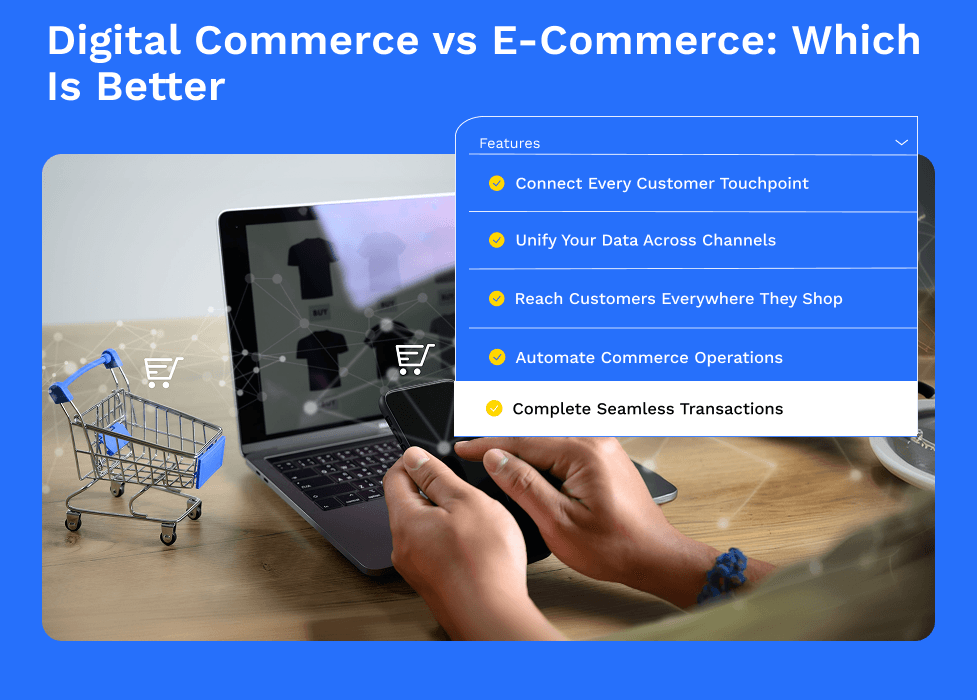
Digital commerce vs E-commerce is a topic of frequent discussion because Digital commerce is the future of the evolving retail industry. Unlike brick-and-mortar stores, e-commerce services are accessible anywhere, and anytime in the world.
Digital commerce is a strategy that provides customers with an engaging, interactive experience that enables them to buy products and services online without human interaction. whereas, e-commerce is the buying and selling of tactile products online.
Digital commerce and e-commerce have been around for a while, and they are starting to become popular with businesses of all sizes. Both types of marketing are used by companies that want to reach consumers in different ways. In the article, we explore a comprehensive overview of digital commerce vs eCommerce in 2025.
What is Digital Commerce?
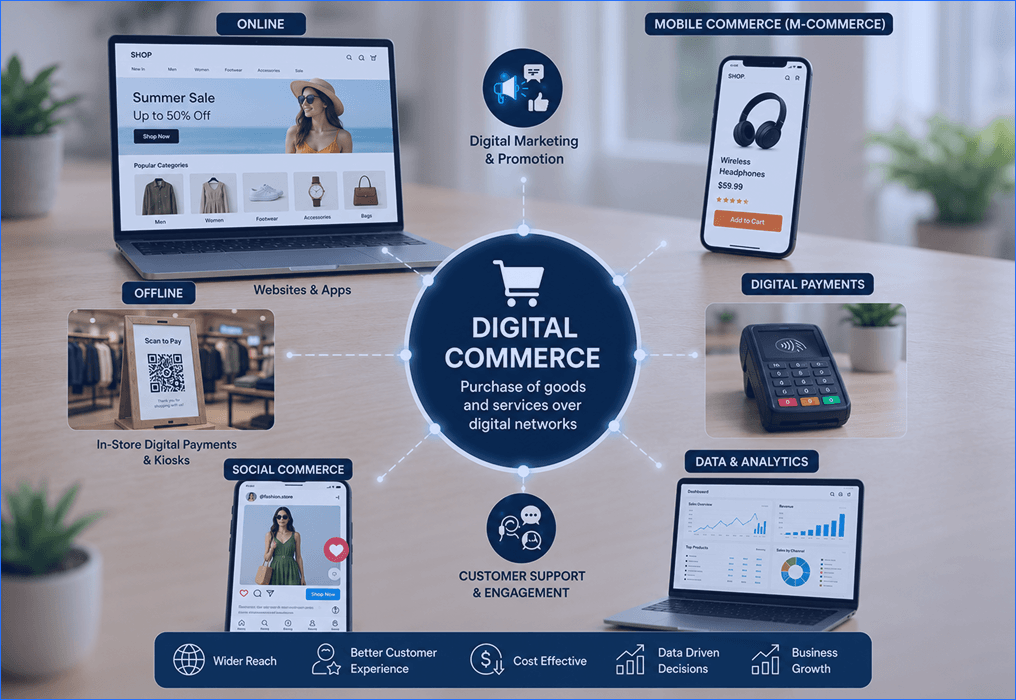
Digital commerce is the purchase of goods and services over digital networks. Digital commerce can be conducted online or offline, but most transactions are done online. The benefits of digital commerce platforms are immense and will continue to grow at an exponential pace in the future. Despite the subtle differences, digital commerce would be eCommerce if it were completely automated, from marketing to sales to product delivery.
What Is E-Commerce?
E-Commerce stands for any online transaction associated with businesses over the internet. A variety of technologies are used in e-commerce to meet the requirements of these processes, such as electronic funds transfers, mobile commerce, online marketing, supply chain management, online transaction processing, and automated data collection systems. With the rise of e-commerce, the retail industry has been profoundly impacted and new jobs and revenue have been generated for small businesses as well as large corporations.
Comparison Between Digital Commerce vs E-Commerce
Area | E-Commerce | Digital Commerce |
| Primary Scope | Online buying and selling transactions | Complete digitally enabled customer journey |
| Customer Journey | Product page, cart, checkout, payment, order | Discovery, marketing, product data, personalization, transaction, fulfillment, service, loyalty, analytics |
| Channels | Websites, apps, marketplaces | Websites, apps, social commerce, marketplaces, local pages, stores, messaging, AI channels |
| Data & Technology | Storefront, payment, inventory, order tools | Commerce platform plus CRM/CDP, marketing automation, analytics, personalization, integrations |
| Products | Physical goods, digital products, services | Physical goods, digital products, services across wider journey |
| Main Goal | Complete an online transaction | Create a connected experience before, during, and after purchase |
How Digital Commerce Works Across the Customer Journey
Digital commerce isn't one thing. It's how each stage of the customer journey connects together. Here's how it works.
1. Product Discovery and Digital Marketing
Customers find you through social media, search engines, email, ads, or word-of-mouth. Digital commerce tracks where customers come from and what messages work. This data feeds back into your marketing so you reach more people like your best customers. E-commerce just has the store. Digital commerce owns the whole discovery process.
2. Product Information, Catalogues, Pricing, Availability
Once customers find you, they need to see what you sell. Digital commerce makes sure your product information is accurate everywhere. Same prices on your website, app, and store. Same availability shown in real-time. If you have multiple locations, customers see local stock. E-commerce shows products. Digital commerce makes sure information is consistent and current everywhere.
3. Personalization and Customer Data
Digital commerce remembers who customers are. What they've bought before. What they browsed. What they liked. This data powers personalization. A returning customer sees different recommendations than a first-time visitor. This requires a customer data platform (CDP) or CRM connected to your commerce system. E-commerce can't do this without the extra systems.
4. Cart, Checkout, Payment, Order Management
This is where e-commerce and digital commerce overlap. The checkout process is nearly the same. But digital commerce tracks cart abandonment, knows why customers drop off, and can send targeted recovery emails. Order management connects to inventory, so if stock runs out, customers are notified automatically. The transaction itself is similar, but the surrounding systems are smarter.
5. Fulfillment, Delivery, Pickup, Store Integration
After purchase, fulfillment happens. Digital commerce can offer multiple options: ship to home, pick up in store, or deliver today from a nearby location. Inventory is unified across channels. If a customer orders online, you can fulfill from the nearest store instead of a warehouse. E-commerce fulfills from one place. Digital commerce uses your whole network.
6. Customer Support, Loyalty, Reviews, Analytics
After the sale, digital commerce keeps working. Customer service teams have full order history and customer context. Loyalty programs track repeat purchases and reward them. Reviews are collected and analyzed. Analytics show which products sell, which channels work best, and where customers drop off. This data informs everything that comes next.
7. The Difference
E-commerce handles the transaction. Digital commerce handles the entire journey before, during, and after the transaction. Each stage connects to the next, creating a seamless experience and generating data that improves future experiences.
Discover how unified digital commerce platforms deliver better customer experiences at every stage of the journey: "Optimizing Customer Experience with a Digital Commerce Platform"
How E-Commerce Expands into Digital Commerce?
E-commerce works. Millions of businesses sell online successfully every day. But as customers expect more, businesses are expanding their approach.
1. Customer Expectations Keep Growing

Customers used to be happy buying online. Now they want seamless experiences across channels. They want to order online and pick up in stores. They want personalized recommendations based on browsing history. They want customer service that knows their order without them repeating information. E-commerce alone can't deliver this. Digital commerce can.
2. Business Needs Become More Complex

A single online store is simple. But when you add multiple locations, multiple channels (website, app, marketplace, social), and customer data, complexity grows. You need to unify inventory across all channels. Keep pricing consistent everywhere. Personalize at scale. Track customers across touchpoints. E-commerce platforms handle transactions. Digital commerce platforms handle all of this.
3. Cross-Channel Analytics Drive Better Decisions

E-commerce shows you what is sold. Digital commerce shows you the entire path to that sale. Which marketing channels brought customers? Where did they browse? What made them convert or drop off? This data is valuable. It helps you spend your marketing budget smarter, improve customer experience, and grow faster. E-commerce doesn't provide this visibility.
4. The Shift Isn't Replacement

E-commerce isn't disappearing. Digital commerce expands it. You keep your online store but connect it to marketing systems, customer data, inventory, and analytics. It's evolution, not replacement. Businesses that master this connected approach grow faster than those managing isolated channels.
Digital Commerce Trends in 2026
Digital commerce is evolving fast. Here's what's shaping the landscape in 2026.
1. Agentic AI for Product Discovery, Service, and Commerce Tasks
AI is moving beyond recommendations. Agentic AI takes actions on behalf of customers. An AI agent can search for products, compare prices, check inventory, answer questions, and process orders without human intervention. This makes shopping faster and easier. Businesses using agentic AI see higher conversion rates and lower customer service costs.
2. Unified Commerce Across Inventory, Pricing, Orders, Stores, and Customer Data
Customers expect consistency. You can't have different prices online and in-store. Different inventory availability on the website and app. Unified commerce means one source of truth for all data. Inventory, pricing, customer information, orders all connected. This complexity is becoming standard.
3. Composable Commerce and API-First Architecture
Monolithic platforms are being replaced by composable solutions. You pick the best tool for each job. Best checkout? One vendor. Best personalization engine? Another. Best analytics? Another. APIs connect them seamlessly. This flexibility lets businesses innovate faster and scale without ripping and replacing entire systems.
4. Conversational and Social Commerce
Shopping through chat, messaging apps, and social platforms is growing. WhatsApp, Instagram, TikTok becoming storefronts. Conversational commerce through chatbots and AI agents handles discovery and transactions. This is where younger customers shop. Brands ignoring this channel lose sales.
5. Real-Time Personalization With First-Party Data
Third-party cookies are gone. Personalization now relies on first-party data customers willingly share. Real-time personalization means showing different content to different users instantly. Recommendations update as behavior changes. This requires strong data governance and customer trust.
6. Local Inventory, Store Pickup, Online-to-Offline Journeys
Buy online, pick up today in-store. Order from your phone, delivered by a nearby store. Physical stores are inventory hubs, not just retail spaces. Seamless online-to-offline experiences drive foot traffic and increase average order value. Location data and real-time inventory make this possible.
7. Scalable and Always-On Commerce
Commerce never stops. Peak seasons require rapid scaling without crashes. Subscription models require reliable systems month after month. Cloud-based infrastructure and AI-powered demand forecasting keep systems running smoothly at any scale.
8. Subscription and Recurring Revenue Models
Predictable revenue through subscriptions is becoming standard. Beauty boxes, grocery subscriptions, membership programs. Recurring revenue is easier to forecast and budget. Customers benefit from convenience and savings. Businesses benefit from stable cash flow.
Explore the challenges digital commerce platforms face and the emerging trends reshaping how businesses operate: "What Is Digital Commerce: Challenges & Trends in 2023"
Advantages of Digital Commerce in 2026
Digital commerce offers real benefits, but only if you're willing to invest in the systems and data that make it work.
Benefit | Business Impact | Requirement |
Connected Customer Journey | More consistent experiences across channels | Unified product, customer, inventory, order data |
Personalization | More relevant content and offers | Consent-aware first-party data and analytics |
Wider Channel Reach | Sell through websites, apps, stores, social, marketplaces | Channel integrations and catalogue governance |
Automation | Faster merchandising, service, campaign operations | Reliable workflows and data quality |
Better Measurement | Understand discovery, conversion, fulfillment, retention | End-to-end analytics |
The Reality: Real Challenges Exist
Digital commerce isn't free or easy. Here's what you actually face.
- Integration Complexity
Connecting different systems requires technical expertise and ongoing maintenance. APIs break. Data doesn't always sync perfectly. This takes resources.
- Data Quality and Governance
Garbage in, garbage out. If your customer data is messy or inconsistent, personalization fails. You need processes to keep data clean across systems.
- Security and Privacy
Handling customer data means security responsibility. GDPR, privacy laws, payment security standards all apply. Breaches are expensive and damage trust.
- Platform and Implementation Cost
Digital commerce platforms cost more than basic e-commerce. Implementation, data migration, and training add up. Budget 6-12 months and significant investment.
- Organizational Adoption
Your team needs to understand and use new systems. Change resistance is real. Training and change management take time.
The Trade-Off
Digital commerce delivers real benefits. But you're trading upfront complexity and cost for long-term growth and efficiency. It's worth it if you're serious about scaling. It's overkill if you're testing a simple online store.
1. Which Is Better: Digital Commerce or E-Commerce?
This is a trick question. You're not choosing between them. E-commerce is your foundation. Digital commerce expands that foundation.
E-commerce is enough if you need a simple online storefront where customers browse, checkout, and you fulfill orders. It works for many businesses. Digital commerce becomes necessary when you need to connect discovery, product data, multiple channels, physical stores, customer profiles, personalization, fulfillment, service, and analytics together.
Most growing businesses use both. E-commerce handles the transaction. Digital commerce handles everything else.
Business Need | Better Starting Point |
| Launch a simple online store | E-commerce |
| Sell across website, app, marketplace, social, stores | Digital commerce |
| Unify inventory, orders, pricing, customer data | Digital commerce |
| Test online sales with limited complexity | E-commerce |
| Build personalized omnichannel experiences | Digital commerce |
The Real Question
Don't ask "which is better?" Ask "what do I actually need right now?" Start with e-commerce. Expand into digital commerce as your business grows and complexity increases. Most businesses follow this path naturally. They outgrow basic e-commerce and need more connected systems.
Digital Commerce vs E-Commerce vs Digital Marketing
These three terms get confused because they overlap. But they mean different things.
Term | Main Purpose | Includes Transaction? | Example |
| Digital Marketing | Attract, engage, nurture audiences | Not necessarily | SEO, social media, paid ads, email |
| E-Commerce | Complete online purchases | Yes | Product pages, cart, checkout, payment |
| Digital Commerce | Manage full digital customer and commerce journey | Yes | Discovery, marketing, commerce, fulfillment, service, loyalty, analytics |
How They Work Together
Digital marketing brings customers to you. E-commerce lets them buy. Digital commerce connects everything so customers have a seamless experience across all touchpoints.
A customer finds you through digital marketing (Facebook ad). Browses your products (e-commerce). Buys something. Receives personalized follow-up (digital commerce). Leaves a review. Gets loyalty rewards. Becomes a repeat customer (digital commerce). All three working together.
You can do digital marketing without e-commerce. You can have e-commerce without digital marketing. But the best businesses combine all three into a unified strategy.
Examples of Digital Commerce
Buying products and services without human interaction is the most common example of B2B digital commerce. Sekel Tech, Slack, Trello, HubSpot, and Lightspeed are examples of collaboration tools and B2B Digital Commerce.
Sekel Tech offers software as a service to businesses and brands. The services offered by Sekel Tech as a B2B Digital commerce platform are inclusive of :- microsites, local listings, Reviews management, Geo-fenced offers, Automated SEO, Product cataloguing, etc.
1. Schneider Electric
Schneider Electric is one of the clients of Sekel Tech. Schneider Electric’s complete product catalog is available online in its web store. Customers can discover and choose the desired product within just a few clicks and add it right into their shopping cart.
2. The Aurelia
The Aurelia team wanted to boost their engagement across the platform using SaaS based solutions for which they chose Sekel Tech. The brand was able to transform and implement the entire campaign with the help of Sekel Tech’s software as service. Aurelia was able to successfully involve a huge number of Monthly Active Users (MAUs).
3. Blackberry
Blackberry discussed the goal of their business and service needs with Sekel Tech. Sekel Tech offered the brand to understand the behaviour of its consumers, see cohorts, read funnels and get an insight on retention rates. With the help of Sekel Tech’s dashboard software, a stepwise plan was created.
Key Components of a Digital Commerce Platform
A digital commerce platform needs several pieces working together. Here's what makes it complete.
1. Product Catalogue and Product Information Management
Your products need detailed information everywhere they're sold. Images, descriptions, specifications, reviews. This data syncs across website, app, marketplace, and store displays. Product information management (PIM) systems keep everything updated and consistent.
2. Pricing, Inventory, and Availability
Customers need to see accurate prices and stock levels. Digital commerce connects inventory across all locations in real-time. If you're out of stock in one store, customers see it. If you have it nearby, they know. Dynamic pricing adjusts based on demand, location, or customer segment.
3. Storefront, Search, Cart, Checkout, Payments
This is the shopping experience. Customers find products through search. Add to cart. Checkout smoothly. Pay securely. This needs to work on websites, apps, and mobile. Payment processing integrates with your accounting and fraud detection systems.
4. Order, Fulfillment, Delivery, Pickup Management
After purchase, orders flow to fulfillment. Digital commerce routes orders to the best fulfillment location. Customers can pick up in-store or have items delivered. Real-time tracking keeps customers informed. Returns and exchanges are handled smoothly.
5. CRM, Personalization, Loyalty, Customer Service
Customer data powers everything. CRM systems store customer history, preferences, and interactions. Personalization engines recommend products based on behavior. Loyalty programs reward repeat purchases. Customer service teams access full context when helping customers.
6. Integrations, Analytics, Security, Scalability
Your platform needs to connect with accounting, ERP, shipping, marketing, and other systems. Analytics track customer behavior, sales, and performance. Security protects customer data and payment information. Infrastructure scales smoothly during peak demand.
See real-world examples of how businesses successfully implement digital commerce across different industries: "Digital Commerce Examples: How E-Commerce is Revolutionizing Business"
Frequently Asked Questions (FAQs)
1. Is digital commerce the same as e-commerce?
No. E-commerce focuses on online buying and selling transactions through websites, apps, or marketplaces. Digital commerce covers the full customer journey: discovery, marketing, personalization, transaction, fulfillment, service, loyalty, and analytics. E-commerce is the transactional core. Digital commerce connects everything before, during, and after the sale to create a seamless experience.
2. What does digital commerce include?
Digital commerce includes product discovery and digital marketing, product catalogues and information, customer data and personalization, storefronts and search, cart and checkout, payments, order management, fulfillment and delivery, customer service, loyalty programs, reviews and analytics. It's the entire digitally enabled customer journey, not just the online transaction itself.
3. Which is better for a small business: digital commerce or e-commerce?
A simple e-commerce setup is the best starting point for a small business. You need a working online store with products, checkout, and payment processing. Digital commerce becomes more valuable as you add channels (app, marketplace, social), locations, customer data, automation, personalization, and complex fulfillment. Start small, expand gradually.
4. What is the difference between e-business and e-commerce?
E-commerce covers online buying and selling of products and services. E-business is broader and includes all digital business operations: procurement, finance, customer service, supply chain, collaboration, human resources, and administration. Digital commerce is part of e-commerce, which is part of e-business. Each layer is more comprehensive than the last.
5. What is the future of digital commerce?
Digital commerce is moving toward agentic AI handling product discovery and service tasks, unified commerce across inventory and pricing, composable technology letting you pick best-of-breed tools, conversational shopping through messaging apps, real-time personalization with first-party data, and seamless online-to-offline journeys. The future connects every touchpoint into one seamless experience.
Conclusion
To succeed in digital commerce, businesses need to have a deep understanding of their customers' preferences and behaviour, which can be achieved through analytical solutions that capture consumer data across various touchpoints. Personalization techniques, AI, and budget optimization can also be leveraged to enhance the commerce digital strategy and improve customer engagement. Overall, the key to a successful commerce digital venture is to stay focused on the customer and their needs and to adapt to the rapidly evolving digital landscape.
How Are Sekel Tech's Digital Commerce Solutions and Services Different from Others?
As observed, Digital Commerce Vs E-commerce, the clear winner is Digital Commerce because it is adapting to the market and changing technology rapidly.
Sekel Tech’s digital commerce solutions and services are designed to enable businesses to sell their products or services online. The key features of Sekel Tech’s digital commerce solution include an easy-to-use interface for customers, a secure payment gateway, and a reliable and scalable infrastructure.
Some of the factors that differentiate Sekel Tech’s digital commerce solution from others are –
1. Customization and Flexibility
A good digital commerce solution should be customizable to meet the specific needs of the business. Sekel Tech’s solutions offer more customization and flexibility to meet specific business requirements.
2. Integration with Other Platforms
A good digital commerce solution should be able to integrate with other platforms like CRM, ERP, and shipping carriers. Sekel Tech’s solutions offer better integration capabilities.
3. Analytics and Reporting
A good digital commerce solution should provide real-time analytics and reporting to help businesses make data-driven decisions. Sekel Tech’s solutions offer more advanced analytics and reporting features.
4. Customer Support
A good digital commerce solution should offer reliable customer support to ensure that businesses can resolve any issues quickly. Sekel Tech’s solutions offer better customer support services.
Sekel Tech offers dynamic tools and software services to boost your sales using the digital commerce platform. We’ve helped our clients to grow their traditional businesses to the next level by making the most of this platform. Call us or contact us online to learn how you can grow your business using Digital Commerce!
Share


Similar Blogs
Loved this content?
Sign up for our newsletter and get the latest tips & updates directly in your inbox.
There’s more where that came from!
 Connect with us