
Artificial Intelligence
AI Discovery Layer: How Brands Win Local Search in 2026
Tue, 02 Jun 2026 18:30:00 GMT
Speak to our Hyperlocal Expert
Everything just changed.
A few years ago, people searched Google. They typed "car dealer near me" and clicked on links. That world is gone.
Now customers ask ChatGPT, Gemini, and other AI agents their questions directly. "Which dealer nearby has this car in stock today?" The AI reads the answer and tells them instantly. No clicking links. No browsing websites.
Half of all shoppers are already doing this. And it's only growing.
Here's the problem:
Most dealers and brands are still optimizing for Google. They're playing yesterday's game. Meanwhile, their customers are using AI and those AI systems can't find them because their data isn't structured right.
This guide explains what changed, why it matters, and exactly what you need to do to win in the AI era. Because when a customer asks AI about your business, you want AI to know the answer.
Let's make that happen.
What Changed? From Google to AI Search
The way consumers discover products and local businesses is changing rapidly. Previously, people searched on Google using keywords like "coffee shops near me," browsed multiple results, and clicked through websites to find what they needed.
Today, AI search is changing that behavior. Users now ask conversational questions on platforms like ChatGPT, Gemini, Claude, and Perplexity and receive direct answers instead of a list of links. For example, someone might ask, "Which coffee shop nearby is open now and offering discounts?"
Unlike traditional search engines, AI systems do not simply rank webpages. They retrieve information from structured and machine-readable data sources. If your business data is not organized and accessible, AI may not recommend you.
For example, when a customer asks, "Which car dealer near me has this model in stock today?" The dealer with accurate inventory and local business data is more likely to appear in the answer. As AI search grows, understanding how AI discovers businesses is becoming essential for local search success in 2026.
What Is an AI Discovery Layer?

An AI Discovery Layer is structured data that AI agents like ChatGPT can read and understand instantly. When a customer asks AI a question, the AI reads this data and recommends your business directly in the answer.
Think of it as organized information that AI systems can easily understand, instead of messy data scattered across different systems.
How It Works Differently from Google Search - Google Search works by ranking websites. You type words, Google shows links, you click and read. But AI Discovery works differently. When someone asks ChatGPT "Which car dealer near me has this model in stock today?", the AI doesn't show links. It reads structured dealer data and tells you the answer directly, including which dealer has the car.
Real Scenario - A customer opens ChatGPT and asks "Which dealer in Bangalore has the Nexon EV Fearless+ variant available with quick delivery?"
The AI reads structured inventory data from dealers. It sees one dealer has updated their stock information hourly. Another dealer's data is old or incomplete. The AI recommends the dealer with clean, current data.
The dealer with structured data gets the sale. The dealer with messy data doesn't even appear in the answer.
That's the AI Discovery Layer in action.
The Shift from SEO to GEO (Generative Engine Optimization)
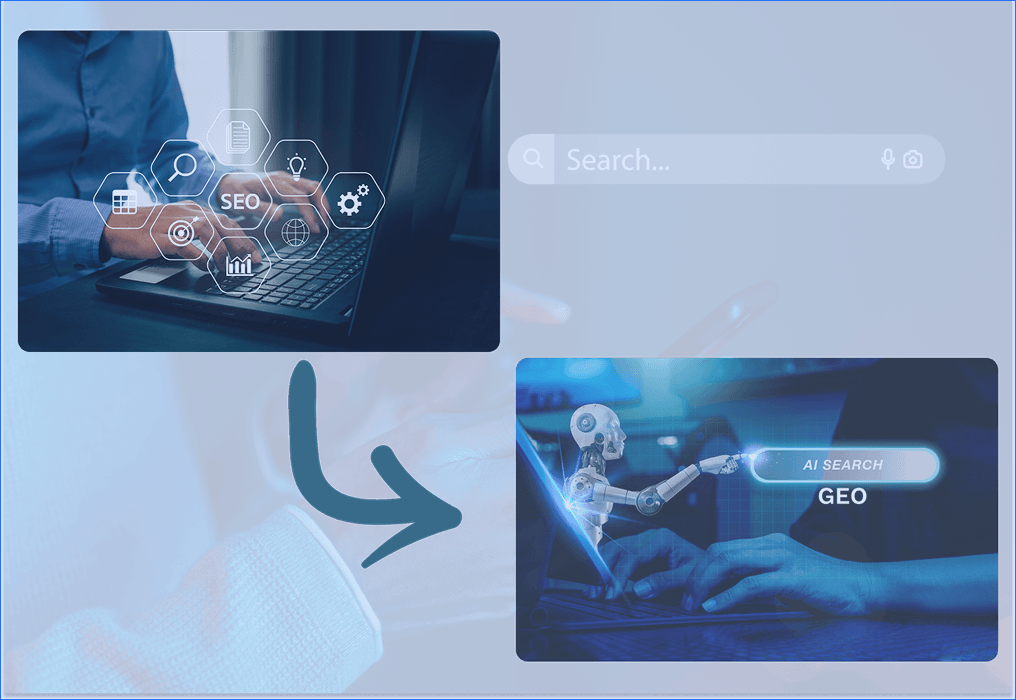
- The Old Game (SEO)
For 20 years, one rule dominated digital marketing: rank on Google. Businesses optimized websites to appear on page one. Google ranked pages based on keywords, links, and user experience. If you ranked higher, you got clicks.
- The New Game (GEO)
Today, AI is replacing Google as the discovery tool. Instead of ranking pages, AI constructs answers directly from structured data. According to research from Google's own AI divisions, 25 percent of search volume is expected to shift from traditional search to AI by 2026.
ChatGPT, Claude, Perplexity, and Gemini now answer customer questions instantly. They don't show links. They show answers. And they pull those answers from structured data, not from ranked websites.
- What Changed
SEO focused on optimizing your website for Google's algorithm. GEO focuses on structuring your data so AI can cite you as the answer.
SEO asked: "How do I rank higher?"
GEO asks: "Is my data structured so AI can read and recommend me?"
- What GEO Requires
Unlike SEO, GEO needs real-time, organized, machine-readable data. Your inventory must update hourly, not monthly. Your location data must be consistent. Your offers must be current. Old data or scattered information doesn't work.
According to Gartner's research on enterprise AI adoption, structured data infrastructure is now a competitive necessity, not an option.
GEO vs SEO: What's the Difference?
For more than two decades, businesses focused on SEO (Search Engine Optimization) to improve rankings on Google. Today, the rise of AI-powered search is creating a new discipline called GEO (Generative Engine Optimization), where the goal is not just to rank but to become part of the answer.
SEO (Search Engine Optimization) | GEO (Generative Engine Optimization) |
| Optimize for Google rankings | Optimize for AI-generated answers |
| Goal: Be on page one | Goal: Be in the answer |
| Websites and pages rank | Data and information get cited |
| Humans browse search results | AI agents retrieve data |
| Periodic updates may work | Real-time updates are critical |
The difference is simple. Traditional SEO helps users find your website. GEO helps AI systems understand and recommend your business directly.
For example, SEO focuses on ranking for a search like "dealer near me." GEO focuses on structuring inventory, location, review, and offer data so an AI assistant can confidently respond, "This dealer has the product in stock and is closest to you."
As AI search adoption grows, businesses will need both SEO and GEO. However, discovery layer optimization is becoming increasingly important because customers are moving from searching for answers to receiving answers directly from AI systems.
Watch the video to understand how structured data powers AI-driven discovery and why brands need a strong data foundation in the era of Generative AI.
The Problem: Why Dealers Are Invisible
Many dealers are losing visibility in AI search, not because they lack inventory or demand, but because their data is difficult for AI systems to access and understand.
1. Your Data Is Stuck in Old Systems
Inventory is often locked inside ERP or DMS platforms. Offers may be shared through emails, spreadsheets, or WhatsApp, while service information is managed separately. AI agents cannot easily read scattered or disconnected data.
2. Data Isn't Connected
One location may have inventory information, another may manage pricing, while reviews sit on different platforms. AI systems need all this information in one place to provide accurate recommendations. Without connected and structured data, businesses become harder to discover.
3. Data Isn't Updated
Many dealers update inventory and offers periodically, but AI systems rely on fresh information. Outdated stock availability, pricing, or business details can lead to missed opportunities and inaccurate recommendations.
Consider a customer asking, "Does dealer X have this car available today?" The dealer's website may contain the answer, but if the inventory data is not structured and machine-readable, the AI system may not find it. Instead, it may recommend a competitor with better AI-ready data.
In the era of AI-powered discovery, dealer visibility depends on structured data, connected systems, and real-time updates.
What AI Systems Need to Recommend Your Business
For an AI agent to recommend your dealer, store, or service location, it needs access to accurate, structured, and up-to-date information. AI systems do not guess or manually browse multiple sources. They rely on machine-readable data that can be retrieved instantly and confidently.
Some of the most important data points AI systems look for include:
- Real-time inventory: Which products or models are currently available?
- Location signals: Address, coordinates, business hours, and contact details.
- Active promotions: Current offers, discounts, financing schemes, or seasonal campaigns.
- Service availability: Delivery options, installation services, appointments, or support capabilities.
- Customer reviews: Ratings and feedback consolidated from platforms such as Google, Facebook, and other review sites.
- Pricing information: Current product pricing, variants, and package details.
The challenge for many dealer networks is that this information exists across multiple platforms and departments. Inventory may be stored in ERP systems, offers managed locally, reviews spread across different channels, and business information updated inconsistently. As a result, AI agents cannot access a complete picture of the business.
The solution is discovery layer optimization through centralized and AI-readable data feeds. When inventory, reviews, offers, location data, and service information are unified into a structured format, AI systems can retrieve, understand, and recommend your business more effectively. In the era of AI-powered discovery, machine-readable data is becoming the foundation of visibility.
Why This Matters Now: The Numbers Behind AI Discovery
The shift to AI-powered discovery is happening faster than many businesses realize. Recent industry research shows that consumer behavior is already changing.
- 50% of consumers: now use AI-powered search for product discovery.
- 25% decline in traditional search volume is expected as users move toward AI assistants.
- 44% of users say AI has become their preferred source for finding products and services.
- 70% of customer journeys are expected to begin through AI-driven interactions by 2028.
These numbers highlight a simple reality: AI is not a future trend. It is already influencing how customers discover businesses today. Brands that fail to make their data AI-ready risk losing visibility at the very moment purchase decisions are being made.
The opportunity is equally significant. Industry projections estimate that $750 billion in consumer spending could flow through AI-powered discovery channels by 2028. Businesses with structured, accurate, and machine-readable data will be positioned to capture this demand, while those relying on disconnected systems may struggle to appear in AI-generated recommendations.
As AI search adoption accelerates, local discovery in 2026 will increasingly depend on how well businesses prepare their data for AI.
Read more insights on AI-powered visibility and the future of discovery: India’s next AI leap will not be about models. It will be about visibility.
Three Strategic Principles for AI Discovery Layer Optimization
As AI-powered search becomes more common, businesses need to rethink how their local data is managed and published. Successful AI discovery layer optimization is built on three key principles.
1. Every Dealer Is a Knowledge Node
In the past, dealers were viewed primarily as sales locations. Today, each outlet must function as a knowledge node that AI systems can understand and recommend. This means inventory availability, location details, customer reviews, service capabilities, operating hours, and local offers should be structured, updated, and machine-readable. When AI agents evaluate a customer query, these signals help determine which dealer becomes part of the answer.
2. Hyperlocal Data Must Be Managed at Scale
AI recommendations rely on accurate local information. Managing structured local data across hundreds or thousands of outlets manually is difficult and often leads to inconsistencies. Businesses need systems that can publish real-time updates for inventory, promotions, store information, and service availability across all locations. Networks that continuously maintain and distribute hyperlocal data are more likely to be discovered and recommended by AI systems.
3. Google Business Profile Is the Bridge
Google Business Profile (GBP) remains one of the most important sources of local business information online. It acts as a bridge between physical locations and AI-readable data. Accurate business details, reviews, photos, categories, and operating hours help strengthen local visibility. However, many dealer networks still under-maintain their GBP listings, creating gaps in discoverability. As AI assistants increasingly rely on trusted local data sources, maintaining complete and active GBP profiles becomes essential for AI Discovery Layer optimization.
Together, these three principles create the foundation for stronger visibility in AI-driven search and help businesses prepare for the future of local discovery.
How to Build Your AI Discovery Layer
Building an AI discovery layer starts with making your business data accessible, accurate, and easy for AI systems to understand. Here are four practical steps to get started.
Step 1: Audit Your Current Data
Begin by assessing your existing data infrastructure. Where is inventory data stored? How frequently is it updated? Are offers, reviews, and service information managed centrally? Also, review whether each outlet has a properly maintained Google Business Profile (GBP).
Step 2: Centralize Dealer Data
Bring critical business information into a unified system. This should include real-time inventory feeds, promotional campaigns, service availability, business details, and customer reviews. Centralized data improves consistency across all locations.
Step 3: Make Data Machine-Readable
AI systems rely on structured data to understand information. Use schema markup, standardized data formats, and consistent business information across locations. Discovery layer optimization depends on making data easy for AI agents to retrieve and interpret.
Step 4: Publish to AI Discovery Channels
Ensure your data is available through key hyperlocal discovery platforms, including Google Business Profile, local business listings, structured feeds, and AI-accessible data sources. The easier it is for AI systems to access your information, the more likely your business is to be recommended.
Watch the video to see how businesses can centralize listings, reviews, content, and customer engagement to create an AI-ready discovery ecosystem.
GBP: Your Current Bridge to AI Discovery
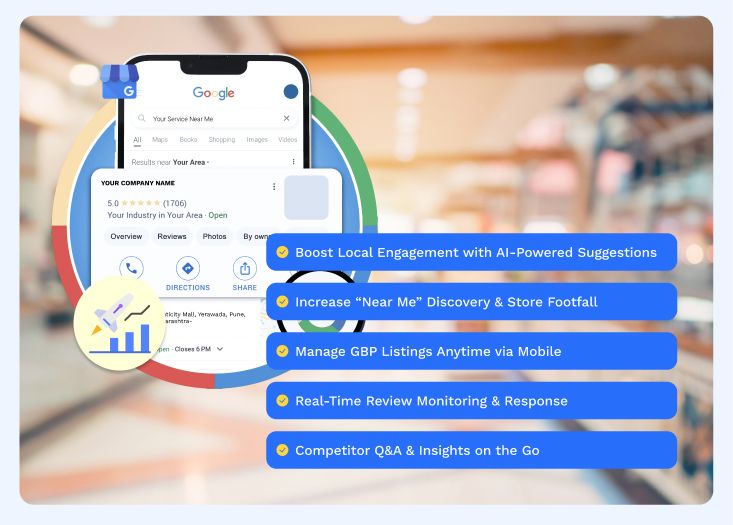
For most businesses, Google Business Profile (GBP) is the simplest and most important starting point for AI discovery. It provides trusted local business information that search engines, maps, and AI systems can use to understand and recommend your locations.
Unfortunately, many dealer networks and multi-location brands still have incomplete or inconsistent GBP listings. Missing business hours, outdated contact details, inactive reviews, poor-quality photos, and outdated offers can limit visibility and reduce trust signals.
To strengthen your AI Discovery Layer, ensure every GBP listing includes accurate business information, updated photos, current offers, customer reviews, products or services, and regular posts. A well-maintained profile improves local visibility today while helping prepare your business for a future where AI increasingly influences customer discovery and purchase decisions.
Real-World Example: Automotive Dealer Network
Imagine a customer asking an AI assistant:
"Which Nexon EV Fearless+ dealer in Whitefield has stock available and can deliver quickly?"
Without an AI discovery layer, the dealer's inventory remains locked inside internal systems such as ERP or DMS platforms. Delivery timelines are unavailable, offers are scattered across channels, and customer reviews are disconnected. As a result, the AI cannot confidently recommend the dealer and may suggest a competitor instead.
With an AI discovery layer in place, inventory feeds are updated in real time, service capabilities are structured, local reviews are accessible, and promotional information is readily available. The AI can instantly identify the nearest dealer with available stock and provide a direct recommendation.
The difference is simple: one dealer is invisible to AI, while the other becomes the answer. As AI-driven local search grows, dealer visibility will increasingly depend on the quality and accessibility of structured data.
Watch the video to see how retailers improve local search visibility and convert online discovery into store visits and customer inquiries.
Frequently Asked Questions (FAQs)
1. What is the AI discovery process?
The AI discovery process is the initial phase of planning and preparing an AI initiative. It typically includes identifying business goals, exploring potential use cases, assessing data and technical requirements, validating feasibility through pilot projects or proof of concepts (POCs), and creating a clear implementation roadmap. This process helps organizations understand where AI can deliver the most value and how to successfully deploy it.
2. How does AI discovery work?
AI discovery works by collecting information from structured data sources such as inventory feeds, business profiles, reviews, location data, and promotions. AI systems analyze this information and generate direct answers or recommendations based on user intent rather than simply ranking webpages.
3. Why is structured data important for AI discovery?
Structured data helps AI platforms understand and interpret business information accurately. When inventory, locations, services, reviews, and offers are organized in a machine-readable format, AI agents can retrieve and recommend your business more effectively in local search and discovery experiences.
4. Is Google Business Profile enough for AI visibility?
Google Business Profile is an important foundation, but it is only one part of an AI Discovery Layer. Businesses also need centralized inventory, offer, review, and location data that can be accessed and interpreted by AI systems.
5. How can businesses prepare for AI-powered local search in 2026?
Businesses should focus on maintaining accurate Google Business Profiles, centralizing dealer and store data, publishing structured information, updating inventory and offers in real time, and implementing an AI Discovery Layer strategy to improve visibility across AI-powered discovery platforms.
Conclusion
The shift from traditional search to AI-powered discovery is already underway. Businesses that invest in structured, connected, and machine-readable data will be better positioned to appear in AI-generated answers and capture future demand. The question is no longer whether AI will influence discovery, but whether your business will be visible when AI makes a recommendation.
Build Your AI Discovery Layer with Sekel Tech
Sekel Tech helps brands and dealer networks centralize inventory, location, review, and promotional data to create an AI-ready discovery infrastructure. By transforming fragmented information into structured, real-time intelligence, businesses can improve visibility, strengthen local discovery, and become the answer customers receive from AI systems.
Share


Similar Blogs
Loved this content?
Sign up for our newsletter and get the latest tips & updates directly in your inbox.
There’s more where that came from!
 Connect with us