
Order-to-Cash
Order-to-Cash (O2C) System: What It Is and Why It Matters
Mon, 08 Dec 2025 12:59:56 GMT
Speak to our Hyperlocal Expert
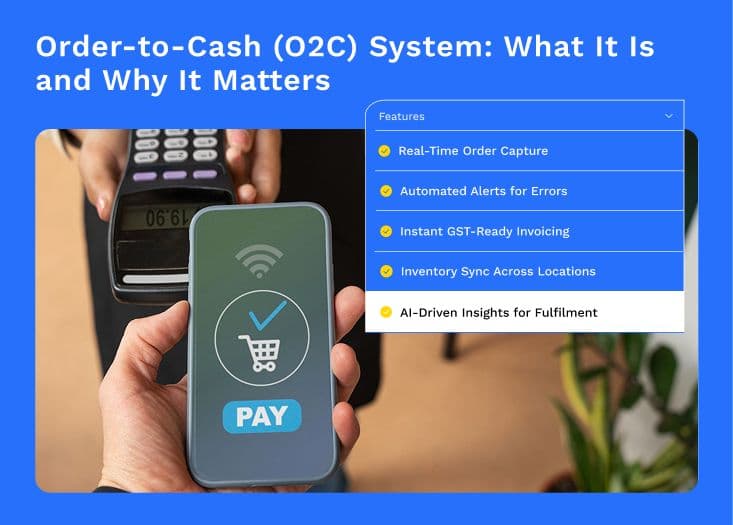
Why do some businesses scale effortlessly while others struggle with delays, revenue leaks, and cash flow gaps? The answer often lies in one critical engine behind the scenes: how efficiently a business converts orders into revenue.
Surprisingly, over 80% of companies still lose money due to manual errors and slow order processing, while businesses that automate their revenue cycle recover payments up to 30% faster. This difference highlights one thing: your growth depends on the strength of your order-to-cash engine.
The Order-to-Cash (O2C) system is the backbone of this engine. It manages every step from order placement to invoicing to final payment, ensuring accuracy, speed, and smooth cash flow. And with modern businesses moving at real-time speed, traditional manual workflows simply can’t keep up. That is why more companies now rely on advanced Order-to-Cash (O2C) platforms to automate tasks, eliminate errors, and improve customer experience.
A strong O2C cycle is not just an operational need. It is a strategic advantage.
In this blog, we explore what the O2C system is, why it matters, and how modern platforms are redefining the revenue cycle.
What Is Order-to-Cash?

Order-to-Cash (O2C) is the complete business process that starts when a customer places an order and ends when the payment is collected. It includes all steps that turn a customer request into actual revenue for the business.
In simple terms, O2C is how a business receives, processes, fulfills, invoices, and gets paid for orders. It ensures the entire journey from order confirmation to final payment runs smoothly and efficiently.
A strong order-to-cash process helps businesses reduce errors, speed up deliveries, improve billing accuracy, strengthen cash flow, and enhance customer satisfaction.
In short, Order to Cash is the heartbeat of revenue operations and a key driver of business growth.
What Is the Order-to-Cash (O2C) System?
The Order-to-Cash (O2C) system is the complete, end-to-end cycle that manages how a business receives an order, fulfills it, bills the customer, and collects payment. It brings together every revenue-generating step in one unified flow, ensuring that nothing is delayed, missed, or manually handled.
At its core, an O2C system connects four major stages: order capture, order fulfillment, invoicing, and payment collection. Instead of teams working in silos, every action is synchronized so the customer receives a smooth and accurate experience from start to finish.
This is where it differs from a basic order management process. Traditional order management only tracks orders. An O2C system goes much deeper. It manages inventory visibility, approvals, credit checks, shipment updates, automated invoicing, payment reconciliation, and real-time revenue reporting.
With customers expecting instant updates, faster deliveries, and zero billing errors, businesses can no longer rely on disconnected tools or manual processes. Modern companies need an integrated O2C ecosystem that gives full visibility, reduces operational friction, and turns orders into revenue with speed and accuracy.
Why Is the Order-to-Cash (O2C) System Important?
The Order-to-Cash (O2C) system is critical because it directly affects how efficiently a business converts orders into revenue. A well-managed O2C system ensures that every step, from order placement to payment collection, is accurate, fast, and seamless.
Here’s why it matters:
1. Improves Revenue Accuracy
By automating order processing and invoicing, O2C reduces mistakes that can lead to revenue loss or disputes.
2. Faster Payouts and Reduced Delays
Automated workflows speed up order fulfillment and payment collection, improving cash flow.
3. Eliminates Manual Errors and Data Mismatch
Integration across sales, operations, and finance ensures consistent data and fewer mistakes.
4. Closes the Loop Between Sales, Operations, and Finance
A unified system connects departments, giving visibility and accountability across the entire revenue cycle.
5. Supports Scaling and Multichannel Commerce
Businesses can handle higher volumes, multiple sales channels, and complex orders without adding extra resources.
In short, an effective Order-to-Cash (O2C) system is not just a process; it is a strategic tool that boosts efficiency, revenue, and customer satisfaction.
Read Also - Smart Billing System for Faster Retail Operations & Growth
B2B vs B2C Order-to-Cash (O2C) System: Key Differences
The Order-to-Cash (O2C) system works differently depending on whether a business serves other businesses (B2B) or direct consumers (B2C). Understanding these differences helps companies design workflows that are faster, accurate, and tailored to their customers.
Aspect | B2B Order-to-Cash (O2C) System | B2C Order-to-Cash (O2C) System |
| Order Complexity | Large, bulk, and often customized orders | Smaller, standard, and simpler orders |
| Credit Checks | Credit approval required before processing | Usually instant payment; minimal credit checks |
| Payment Cycles | Longer payment terms (30–90 days typical) | Immediate or short-term payments (COD, online payments) |
| Payment Type | Contract-based invoicing, bank transfers | Instant payments via cards, wallets, or UPI |
| Workflow | Often manual or semi-automated; multiple approvals | Mostly automated and fast; minimal approvals |
| Customer Interaction | Dedicated account managers; ongoing relationship | Self-service, fast checkout, limited interaction |
In both cases, a modern Order-to-Cash (O2C) platform can streamline operations, reduce errors, and ensure timely payments, whether serving enterprises or individual customers.
Common Challenges Faced by Multi-Location Brands
Managing revenue efficiently becomes increasingly complex for brands operating across multiple stores, warehouses, or regions. Many multi-location brands face challenges that slow down cash flow, create errors, and impact customer experience.
Key challenges include:
- Manual Data Entry Errors: Multiple locations often rely on manual entry, increasing mistakes in invoices, payments, and stock records.
- Delayed Invoicing: Billing across various locations can be slow, delaying payments and affecting revenue predictability.
- Inventory Mismatch Across Locations: Without a unified system, orders may be confirmed for products unavailable in certain stores or warehouses.
- Lack of Visibility: Tracking orders, payments, and fulfillment in real time is difficult without centralized systems.
- Payment Delays: Handling multiple payment channels across locations can slow revenue collection.
- Coordination Challenges: Synchronizing sales, stock transfers, and invoicing across stores is complex and prone to errors.
A modern Order-to-Cash (O2C) system or an all-in-one O2C platform helps brands overcome these challenges by connecting all locations, automating workflows, and providing real-time visibility across sales, inventory, invoicing, and payments. This ensures faster cash collection, fewer errors, and a seamless experience for customers regardless of the order source.
Order-to-Cash (O2C) System Best Practices
To overcome the common challenges faced by multi-location brands, it is essential to follow best practices when implementing a modern Order-to-Cash (O2C) system. These practices help streamline operations, reduce errors, and accelerate revenue collection.
Key best practices include:
- Automate Wherever Possible: Use the STP automation system for order entry, invoicing, and payment reminders to reduce mistakes and save time.
- Minimize Manual Touchpoints: Limit human intervention in repetitive tasks to prevent errors and speed up the O2C cycle.
- Keep Real-Time Inventory Sync: Ensure inventory is updated across all locations and channels to avoid stock-outs or over-selling.
- Provide Multiple Payment Options: Offer various payment methods such as cards, wallets, UPI, and net banking to make transactions seamless for customers.
- Integrate All Systems: Connect ePOS, OMS, CRM, and ERP to create a unified view of orders, payments, and customer data.
- Track Payment Behavior and Reorder Patterns: Analyze customer payment habits and purchase patterns to forecast cash flow and optimize stock.
- Maintain Transparent Customer Communication: Keep customers informed about order status, invoices, and payment confirmations to enhance trust and satisfaction.
Following these best practices with a reliable Order-to-Cash (O2C) platform allows brands to manage multi-location operations efficiently, reduce delays, and improve overall revenue performance.
Read Also - Smart Billing Software: A Game-Changer for Modern Brands
Benefits of a Strong Order-to-Cash (O2C) System
Implementing a robust Order-to-Cash (O2C) system provides multiple advantages for businesses of all sizes. From faster cash flow to improved customer experience, here are the key benefits:
Benefit | How It Helps Your Business |
| Faster Payouts | Accelerates revenue collection and improves cash flow across locations. |
| Lower Operational Cost | Reduces manual work, errors, and redundancies in the O2C cycle. |
| 100% Process Visibility | Provides real-time tracking of orders, invoices, and payments. |
| Fewer Errors | Automation ensures accuracy in billing, payments, and inventory. |
| Real-Time Reconciliation | Keeps accounts up to date with instant tracking of transactions. |
| Improved Customer Satisfaction | Faster deliveries, accurate invoices, and clear communication enhance trust. |
| Scalability for Large Volumes | Handles high order volumes, multiple locations, and complex workflows without extra resources. |
A modern Order-to-Cash (O2C) platform helps brands realize these benefits by unifying sales, inventory, invoicing, and payments in one system, ensuring smooth operations and predictable revenue growth.
Sekel Tech’s All-in-One Order-to-Cash (O2C) Platform
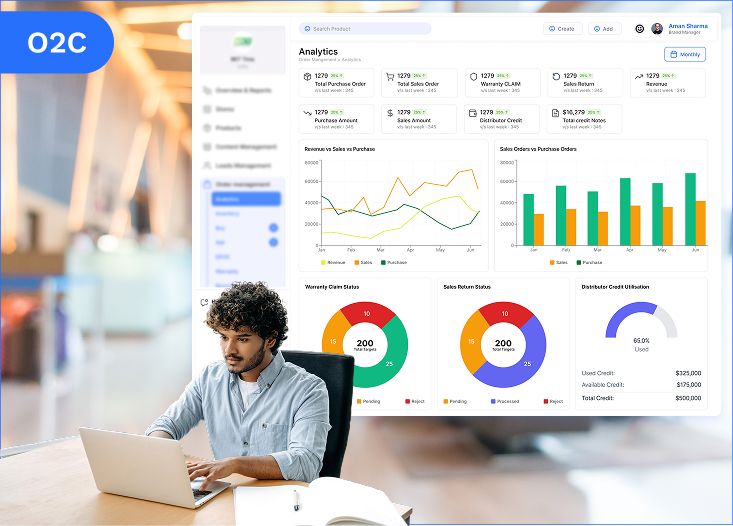
Sekel Tech’s new Order-to-Cash (O2C) system is designed to help brands streamline revenue operations across multiple locations. Built on the philosophy of Omnilocal O2C, the platform connects every part of the business from order discovery to delivery to cash collection, ensuring accuracy, speed, and seamless execution.
Key Capabilities:
1. Real-Time Order Capture
Collects orders instantly from all channels, including online, in-store, or via distributors, ensuring no opportunity is missed.
2. Inventory Sync Across Locations
Synchronizes stock across local stores, warehouses, and dark stores for accurate availability and order fulfillment.
3. Unified Fulfillment
Supports multiple fulfillment models, including click and collect, home delivery, and hyperlocal delivery.
4. Instant Invoicing and GST-Ready Billing
Automatically generates accurate invoices compliant with GST regulations, reducing delays and errors.
5. Integrated Payments
Accepts multiple payment methods, including UPI, cards, and wallets, for faster cash collection.
6. Complete Reconciliation Dashboard
Provides real-time visibility of all orders, payments, and reconciliations, ensuring transparency and control.
7. Task Manager Integration
Ensures on-ground execution and delivery through coordinated task management.
8. AI-Driven Insights
Optimizes order routing, predicts fulfillment needs, and enhances operational efficiency.
Sekel Tech closes the entire loop from discovery to delivery to cash, enabling brands to automate, integrate, and scale their revenue operations without gaps or delays.
Additional Benefits for Multi-Location Brands:
- Centralized onboarding and verification for distributors and retailers
- Role-based access and maker-checker-approval workflows for Sales, Finance, and Logistics
- Faster deliveries, reduced operational errors, and real-time tracking across locations
By combining these capabilities in a single Order-to-Cash (O2C) platform, Sekel Tech empowers brands to turn complex, multi-location operations into a smooth, fully automated revenue engine.
Who Should Use an Order-to-Cash (O2C) Platform
A modern Order-to-Cash (O2C) platform benefits businesses across industries that want to streamline orders, improve cash flow, and scale efficiently. Key industries include:
- Fitness & Wellness: Fitness clubs, gyms, health centers, wellness chains, pharmacies
- Automotive: Car dealerships, two-wheeler and three-wheeler manufacturers, tractor and agriculture machinery companies
- Banking & Finance: Insurance providers, banks, NBFCs, financial service providers
- Consumer Electronics & Appliances: Electronics retail chains, appliance distributors, tech product retailers
- Beauty & Personal Care: Cosmetics, skincare, haircare, and personal care retail chains
- Furnishing & Home Decor: Furniture stores, home decor outlets, auto services, repair and maintenance chains
- Food & Beverages / FMCG: Food manufacturers, packaged goods companies, beverage and FMCG distributors
- Fashion & Apparel: Clothing, footwear, and accessory brands, retail stores, multi-location outlets
- Construction & Paints: Construction material suppliers, paint companies, hardware and building solution providers
- Jewelry: Jewelry and precious metals retailers
- Travel & Hospitality: Travel agencies, tourism operators, hospitality chains
- Retail & Department Stores: Large retail chains, department stores, e-commerce platforms
This format is easier to read and keeps the list concise while highlighting all the sectors that can benefit from a robust Order-to-Cash (O2C) system.
Frequently Asked Questions (FAQs)
1. What is the difference between O2C and C2C?
The Order-to-Cash (O2C) system covers the entire revenue cycle for businesses; from order capture to payment collection. C2C (Consumer-to-Consumer) refers to transactions between individual consumers and does not involve a full business revenue cycle.
2. What is the purpose of O2C?
The main purpose of an O2C system is to streamline order management, ensure accurate billing, accelerate payments, and provide visibility across all departments to improve cash flow.
3. What is the billing process in O2C?
Billing in O2C involves generating accurate invoices after order confirmation, ensuring GST or tax compliance, integrating payment options, and tracking payment status until reconciliation.
4. What is the correct order of the O2C cycle?
The standard O2C cycle includes:
- Order Capture
- Credit Verification
- Order Fulfilment
- Invoicing
- Payment Collection
- Reconciliation
5. What is the O2C process?
The O2C process is the end-to-end workflow that starts with receiving a customer order and ends with payment collection and financial reconciliation. It integrates sales, finance, and logistics to ensure smooth operations and faster revenue realization.
Conclusion
A strong Order-to-Cash (O2C) system or platform helps businesses streamline operations, reduce errors, and accelerate cash flow. Multi-location brands often face challenges like delayed invoicing, inventory mismatches, and manual errors, but a modern O2C platform overcomes these hurdles. With features such as real-time order capture, inventory sync, unified fulfillment, instant invoicing, integrated payments, AI-driven insights, and task management, Sekel Tech’s Omnilocal O2C platform closes the loop from discovery to delivery to cash. Businesses across industries, including retail, automotive, FMCG, consumer electronics, and healthcare, can automate workflows, improve revenue accuracy, reduce operational costs, and enhance customer satisfaction.
Explore how Sekel Tech’s O2C platform can transform your revenue operations by contacting growth@sekel.tech!
Read More Blogs -
1. All-in-One Intelligent EPOS: Top 10 Features for Retailers
2. Omnilocal Inventory Management Platform for Smarter Retail
3. Warranty & Service Management System for Every Retail Store
Share


Similar Blogs
Loved this content?
Sign up for our newsletter and get the latest tips & updates directly in your inbox.
There’s more where that came from!
 Connect with us