
Location Based Marketing
Mastering Location Performance Strategies for Store Chains
Tue, 14 Oct 2025 10:30:11 GMT
Speak to our Hyperlocal Expert
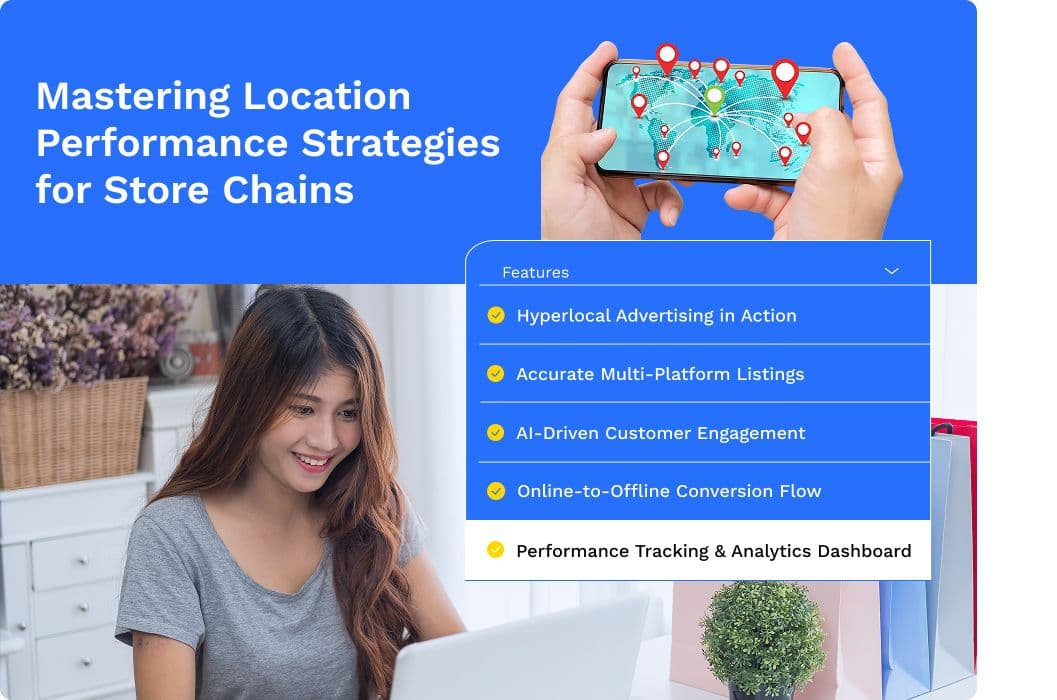
This post was originally published in Dec 2024 and was updated in Jun 2026 for accuracy and comprehensiveness.
Running a store chain? Location matters more than ever. But it's not just about picking the right physical spot anymore.
76% of local searches on Google lead to a store visit within 24 hours. Yet most retailers still use outdated location strategies that ignore the digital side.
Today's customers search on mobile. They check Google Maps. They read reviews. They ask AI agents for recommendations. If your store isn't visible online, they never find you offline.
This guide covers modern store location strategy. The approach that combines physical presence with digital visibility, data tracking, and customer engagement. Whether you run one store or 100, these tactics work.
What is a Location Performance Strategy?

A Location Performance Strategy is a structured plan that helps store chains optimize how and where each location operates to achieve maximum impact. It goes beyond simply choosing a store location; it combines strategic placement, online visibility, customer engagement, and revenue tracking into one cohesive approach.
In today’s retail environment, customers interact with brands both online and offline. A robust Location Performance Strategy ensures that every store is not only physically accessible but also digitally discoverable. It involves tracking key performance indicators such as footfall, conversion rates, local search rankings, and customer engagement metrics.
Effective Location Performance Strategies enable businesses to make data-driven decisions, like adjusting store hours, running targeted promotions, or improving online listings for underperforming locations. By integrating analytics and hyperlocal insights, brands can increase visibility, boost customer trust, and ultimately drive measurable growth across all stores.
Why Location Performance Optimization Matters
Three simple reasons:
Reason 1: Visibility Drives Footfall
Customers can't visit stores they don't know exist. Location performance optimization ensures your store appears when nearby people search for what you sell. More visibility = more foot traffic.
Reason 2: Engagement Drives Conversions
Visibility gets them interested. Engagement turns interest into action. When you personalize offers, respond to reviews, and engage on social media, customers actually visit and buy.
Reason 3: Data Drives Growth
Every metric tells a story. Footfall numbers, conversion rates, customer reviews, sales per location. Data shows what's working and what needs fixing. You optimize based on facts, not guesses.
Why Traditional Location Strategy Fails Today
The old playbook: Find a good location. Open a store. Hope customers find you.
That approach is dead.
Here's why: 80% of customers now search on mobile or use voice search. They ask "Which store nearby has this in stock?" They read reviews before visiting. They expect real-time inventory information. They check Google Maps.
If your store information is wrong, outdated, or missing from these platforms, you're invisible. Customers choose your competitor instead.
Traditional location strategy focused on foot traffic only. Modern strategy focuses on digital discovery + foot traffic combined.
The stores winning today appear in local search results. They have accurate listings everywhere. They engage customers quickly. They track performance and adjust.
5 Core Elements of Modern Store Location Strategy
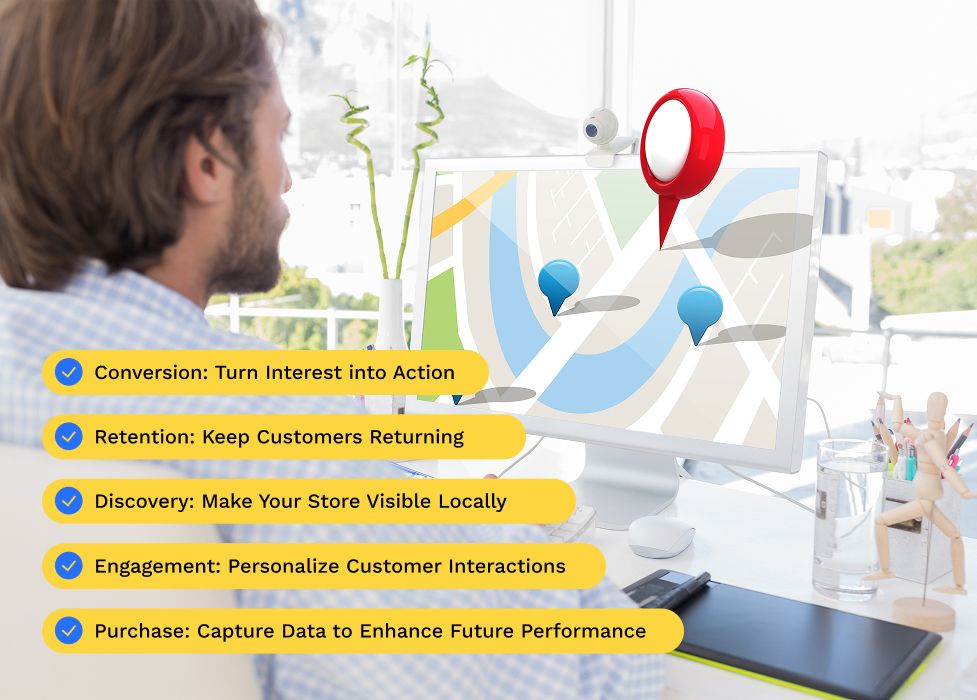
A strong Location Performance Strategy helps store chains maximize the impact of every location by improving visibility, engagement, and revenue. Implementing actionable Location Performance Strategies ensures that each store performs at its best and delivers measurable results.
1. Discovery: Make Your Store Visible Locally
The first step is getting noticed. Hyperlocal targeting ensures that each store appears in relevant local searches, maps, and social platforms. Hyperlocal Discovery Platform helps attract potential customers while they are still in the “unknown” phase, increasing the chances they engage with your brand.
2. Engagement: Personalize Customer Interactions
After discovery, the goal is to turn visitors into known prospects. By tracking clicks, inquiries, and other interactions, the platform creates detailed customer profiles. This enables store chains to deliver tailored content, offers, and messages, improving engagement and laying the groundwork for conversion.
3. Conversion: Turn Interest into Action
Once a customer engages, it’s essential to guide them to the store. Features like Click-to-Drive help customers reach physical locations, while tracking calls, form submissions, and map clicks ensure online engagement translates into actual visits. This allows store chains to optimize campaigns for each location effectively.
4. Purchase: Capture Data to Enhance Future Performance
Every purchase is an opportunity to improve your strategy. Integrating ePOS and CRM systems captures transaction data, activates warranties, and enriches customer profiles. These insights enable store chains to refine their marketing strategies, manage inventory effectively, and enhance the customer experience at each location.
5. Retention: Keep Customers Returning
Retention focuses on building long-term loyalty. Automated notifications, follow-ups, and personalized messages maintain engagement after the purchase. Tracking customer behavior across locations allows retailers to implement effective Location Performance Strategies that encourage repeat visits, enhance trust, and increase lifetime value.
This cycle repeats: Discover → Engage → Convert → Purchase → Retain → Repeat
Read Also - 10 Best Online and Offline Store Management Software in 2026
10 Location Performance Strategies for Store Chains
Optimizing store locations isn’t just about being discoverable online. With Sekel Tech’s AI-driven platform, retailers can turn local marketing into measurable outcomes. Here are 10 actionable Location Performance Strategies for multi-location stores:
1. Location Performance Strategy - Hyperlocal Advertising Campaigns
Targeting the right neighborhoods is crucial to attracting nearby customers. With Digital Campaign Management, stores can run hyperlocal ads that appear to the audience most likely to visit, increasing footfall and ensuring marketing budgets are spent effectively.
2. Location Performance Strategy - Accurate Multi-Platform Listings
Consistent and up-to-date store information is essential for discoverability. Listing Management ensures every store’s address, hours, and services are accurate across Google Maps, directories, and local search platforms, reducing errors and improving customer trust.
3. Location Performance Strategy - AI-Driven Engagement
Personalized engagement helps convert visitors into loyal customers. Using Sekel Agentic AI, stores can automate responses to inquiries and reviews, ensuring timely interactions that enhance customer satisfaction and brand credibility.
4. Location Performance Strategy - Localized Promotions and Offers
Store-specific promotions drive in-store traffic effectively. Content Management (CMS) allows retailers to create targeted offers and messages tailored to each location, encouraging nearby customers to visit and boosting sales.
5. Location Performance Strategy - Online-to-Offline Conversion Optimization
Converting online interest into physical store visits is key. Lead Management tracks customer inquiries, guiding potential buyers from clicks and form submissions to actual in-store visits, improving conversion rates for each location.
6. Location Performance Strategy - Reputation Management and Reviews
A positive reputation builds trust and drives more customers. AI Review & Response Management monitors and automates responses to customer reviews, helping stores maintain credibility and encourage repeat visits.
7. Location Performance Strategy - Location-Specific Content Marketing
Engaging local audiences with relevant content enhances brand connection. Store Microsites enable each store to share updates, events, and promotions specific to its community, increasing local awareness and engagement.
8. Location Performance Strategy - Benchmarking Across Locations
Comparing store performance highlights strengths and improvement areas. Real-Time Sales Conversion Analytics provides insights on sales, footfall, and engagement, helping identify top-performing stores and areas needing attention.
9. Location Performance Strategy - Resource and Inventory Optimization
Efficient staffing and inventory allocation maximize store performance. Smart EPOS tracks sales and stock levels in real-time, helping stores adjust resources based on demand and maintain smooth operations.
10. Location Performance Strategy - Performance Tracking with Location Performance Score (LPS)
Measuring visibility, engagement, and conversions ensures continuous improvement. Sekel Agentic AI calculates the Location Performance Score for each store, providing actionable insights to optimize operations and drive revenue growth.
Read Also - 10 Location Performance Optimization Tips for Store Owners
How to Implement Location Strategy in 5 Steps
Step 1: Analyze Current Performance
Check your baseline. How many visitors monthly? What's your conversion rate? How many reviews? Use Google My Business insights and store data.
Step 2: Optimize Listings
Update Google My Business: photos, hours, address, phone, website. Ensure information is accurate on Google Maps, Apple Maps, Facebook, and Yelp.
Consistency = trust = conversions.
Step 3: Launch Hyperlocal Campaigns
Run geo-targeted ads within 3-5 km of your store. Create location-specific offers. Post on social media about local events and partnerships.
Step 4: Track Conversions
Monitor: clicks on listings, phone calls, form submissions, foot traffic, and reviews. Google My Business shows traffic sources. Analytics shows conversions.
Step 5: Refine Based on Data
Monthly review: Did foot traffic increase? Which campaigns worked? Where are the gaps? Make small adjustments and test new offers.
Watch the video to learn how to track interactions, convert leads into in-store visits, and optimize your location performance with actionable strategies.
Sekel Tech - AI-Powered Location Performance Optimization
Sekel Tech transforms how multi-location retailers optimize store performance by combining AI, analytics, and hyperlocal marketing strategies into a unified platform. Its AI-powered tools help businesses monitor, analyze, and improve every aspect of each store’s operations from visibility and engagement to conversions and retention.
With Sekel Tech, retailers can leverage features like Sekel Agentic AI, Listing Management, Store Microsites, Smart EPOS, and Lead Management to create a comprehensive Location Performance Strategy. These tools enable automated hyperlocal marketing campaigns, real-time performance tracking, and personalized customer engagement, ensuring each store reaches its maximum potential.
By integrating online and offline insights, Sekel Tech provides actionable recommendations, allowing businesses to allocate resources efficiently, optimize inventory, and tailor marketing efforts for each location. Whether it’s driving footfall, improving customer experiences, or boosting revenue, Sekel Tech’s platform empowers retailers to implement measurable, data-driven Location Performance Strategies across their entire store network.
Watch the video to discover how managing listings, content, reviews, and sales from a single platform simplifies local marketing and drives results. "Manage Listings, Content, Reviews & Sales - All in One Place"
Key Takeaways on Location Performance Strategy
- A strong Location Performance Strategy boosts visibility, engagement, and revenue for every store.
- Hyperlocal advertising drives footfall by targeting the right neighborhoods.
- Accurate multi-platform listings ensure customers can easily find your stores.
- AI-driven engagement automates interactions and improves customer satisfaction.
- Store-specific promotions increase in-store traffic and local sales.
- Online-to-offline conversion optimization turns digital interest into real visits.
- Reputation management and reviews build trust and encourage repeat business.
- Location based content marketing strengthens community engagement.
- Benchmarking across stores identifies high performers and areas needing improvement.
- Performance tracking with metrics like LPS ensures continuous improvement.
Frequently Asked Questions (FAQs)
1. What is a store location strategy?
A store location strategy is a comprehensive plan that combines physical store placement, online visibility, and customer engagement tactics. It helps each location attract nearby customers, increase foot traffic, and maximize revenue. A good strategy ensures your store is discoverable online and provides excellent experiences that convert visitors into loyal customers.
2. How do you measure location performance?
Measure location performance by tracking multiple metrics: foot traffic count, online clicks from search and maps, conversion rates, customer reviews and ratings, and Location Performance Score (LPS). Use real-time dashboards to monitor these metrics monthly. Compare performance across locations to identify strengths, weaknesses, and opportunities for improvement. Data drives better decision-making.
3. What makes a good location strategy?
A good location strategy combines data analytics, hyperlocal targeting, accurate multi-platform listings, and personalized customer engagement. It must adapt to how modern customers search: mobile devices, voice search, and AI recommendations. Include Google My Business optimization, location-specific promotions, review management, and continuous performance tracking. Flexibility and data-driven adjustments ensure sustained growth.
4. How does location strategy improve multi-location chains?
Location strategy enables consistent performance standards across all stores while allowing customization for each market. It identifies top-performing locations and reveals problem areas needing improvement. Enables targeted optimization for underperforming stores. Helps allocate resources efficiently, manage inventory better, and tailor marketing efforts. Result: stronger overall chain performance and increased profitability across the network.
5. What's the difference between location and marketing strategy?
Location strategy focuses on optimizing each store's specific performance through discovery, engagement, and conversion locally. Marketing strategy is broader, addressing company-wide brand building and customer acquisition. Location strategy is hyperlocal and detailed. Marketing strategy is regional or national. Both are essential: marketing drives awareness, location strategy converts awareness into store visits and sales.
Conclusion
Mastering Location Performance Strategies is essential for modern retail, helping store chains optimize visibility, engagement, and revenue across all locations. By implementing data-driven, AI-powered approaches, retailers can stay ahead of competition and deliver personalized experiences that convert visitors into loyal customers. Sekel Tech’s platform provides the tools and insights needed to execute these strategies effectively from hyperlocal campaigns and listings management to performance tracking and AI-driven engagement. Explore Sekel Tech today to transform your multi-location operations and drive measurable results. Your stores’ visibility, engagement, and revenue growth depend on the strategies you implement today.
Read More Blogs -
1. Effective Geolocation Advertising Strategies That Work in 2026
2. Geolocation Advertising: Challenges and the Solution
3. Mobile Dynamics: Crafting Effective Location-Based Promotions
4. Best Location-Based Marketing Platforms for Brands in 2026
Share


Similar Blogs
Loved this content?
Sign up for our newsletter and get the latest tips & updates directly in your inbox.
There’s more where that came from!
 Connect with us