
Multi-Location Marketing
Multi-Location Content Management Platform: Complete Guide
Wed, 18 Feb 2026 09:40:12 GMT
Speak to our Hyperlocal Expert
A customer searches for "AC repair near me" or "best jewellery store near Whitefield." Within minutes, they're ready to visit. 76% of these searches lead to a store visit within 24 hours. The intent is high. The opportunity is immediate.
Yet most multi-location brands serve the same generic content to everyone, regardless of location.
Here's the problem. You manage 500 stores across 500 different markets. Each location faces unique competition, seasonal demand, and customer preferences. But your website treats them all the same. Mumbai gets identical content as Pune, even though their customers want completely different things.
Traditional content systems weren't built for this. They manage pages, not places. They publish content but don't adapt it.
This creates a disconnect. Customers searching locally expect local answers. What's available at their nearest store. Current promotions in their area. Actual inventory they can buy today. When your content ignores their location, they choose competitors who show up with relevant information.
Multi-location content management fixes this. Instead of one generic website, you deliver location-specific experiences at scale. Each store gets optimized content while you maintain centralized control.
A multi-location content management platform lets you manage hundreds of store pages from one dashboard. Update once, and the system automatically customizes content for each location based on local data.
The result: customers find what they need. Search rankings improve because content matches local intent. Your team saves hours previously wasted on manual updates.
This guide explains what multi-location content management involves, how it works, why it matters for local search, and what results to expect.
What Is a Multi-Location Content Management Platform?
A multi-location content management platform lets you manage content for hundreds of stores from one place while automatically customizing what each location shows.
Picture this. You run 200 stores. Each needs accurate hours, current inventory, local promotions, and relevant content. Manually updating all 200 takes days and creates mistakes.
A multi-location content management platform fixes this. Update once. The system customizes and pushes to each store automatically.
How it works: Corporate sets brand standards, templates, and approvals. Store pages adapt automatically using local inventory, regional demand, neighborhood data, and seasonal patterns.
Old systems show identical content everywhere. Mumbai sees the same page as Jaipur. A multi-location content management system knows better. Mumbai highlights monsoon gear in July. Jaipur shows summer products. Same brand, different relevance.
This matters for 50+ location retailers, restaurant chains, dealer networks, and franchises where customers expect local information.
Example: Someone in Whitefield searches for a "furniture store near me." Your Whitefield page appears showing that store's inventory, today's hours, local delivery, and current neighborhood offers. Not your homepage. Not another city. Their actual nearest store with relevant details.
That's the difference.
Watch the video to see how a unified content management platform simplifies operations for multi-location brands. "Complete Content Management Platform for Multi-Location Retail"
How Does Multi-Location Content Management Work?
The system operates on three layers that balance corporate control with local flexibility.
Layer 1: Central Control
Corporate maintains one master library with approved brand assets, messaging templates, visual guidelines, and compliance rules. Nobody publishes off-brand content. Approval workflows ensure campaigns get reviewed before going live. This protects brand consistency across every location.
Layer 2: Local Intelligence
The platform pulls location-specific data automatically. Store addresses and service areas. Current inventory levels. Local competitor activity. Customer search patterns in that neighborhood. Regional buying behavior. Seasonal demand shifts.
This data feeds into what each store page shows. No manual input needed.
Layer 3: Dynamic Delivery
When someone visits or searches, the system serves customized content based on their location and nearest store. Content updates automatically across your website, Google Business Profiles, store microsites, and social platforms.
Real workflow example:
Headquarters launches a Winter Sale campaign. Creates one master template.
The multi-location content management platform automatically customizes it for each store. Mumbai's page shows light jackets (their inventory). Delhi's page shows heavy coats (their inventory). Bangalore skips winter wear entirely, highlighting other products.
Published everywhere in one workflow. No manual store-by-store updates. No inconsistencies.
Store managers see their customized version. Can make approved tweaks within guidelines (adjust store hours, add local note). Changes go live instantly without waiting for corporate approval on minor edits.
Customers searching locally find relevant content. Google ranks these pages higher because they match local search intent. Your team saves hours previously spent coordinating updates across locations.
That's how multi-location content management turns one action into hundreds of locally relevant experiences.
Watch the video to see how one unified platform manages content, listings, and performance across hundreds of store locations. "Manage Listings, Content, Reviews & Sales - All in One Place"
Why Multi-Location Content Management Matters
Four measurable reasons this approach drives real business results.
1. Local Search Dominance
46% of all Google searches have local intent. "Near me" searches grew over 200% in recent years. Businesses publishing location-specific content rank up to 3 times higher in local results.
Generic corporate pages don't cut it. When someone searches "shoe store near Koramangala," Google shows stores with optimized local pages, not your homepage. A multi-location content management platform ensures every store has geo-relevant pages that rank where customers actually search.
2. Conversion at Scale
Generic content converts 2 to 3% of visitors. Localized, context-driven content converts 18 to 22%. That's not a small improvement. That's a fundamental difference in performance.
When customers see their nearest store's actual inventory, current hours, and neighborhood-specific offers, they act. Multiply that across hundreds of locations and revenue impact becomes significant.
3. Operational Efficiency
Managing 200 stores through traditional systems means 200 manual updates for each campaign. It takes days. Creates inconsistencies. Someone always gets missed.
Multi-location content management lets you update once centrally. The system generates localized variations automatically. Content management time drops 85%. Campaigns launch faster. Errors disappear.
4. Competitive Edge
Customers expect relevance now. Brands delivering location-specific experiences consistently see 73% higher local visibility, 40 to 60% growth in store traffic from online searches, and 25 to 35% better conversion rates.
Your competitors either do this well or they don't. If they don't, you win by default when customers search locally. If they do and you don't, you're invisible.
The gap between generic and local content management strategy determines who captures high-intent local searches. That's not a theory. That's measurable market share.
Read Also - Hyperlocal Content Management System: Powering Retail Brands
What Benefits Does Multi-Location Content Management Provide?
Multi-location content management delivers six operational and revenue advantages.
1. Hyperlocal Personalization at Scale
Deliver location-specific promotions, inventory, hours, and regionally relevant messaging automatically across all stores, achieving up to 3x better engagement than generic content.
2. Unified Multi-Channel Management
Manage store microsites, Google Business Profiles, social media pages, and dynamic store locators from one platform, reducing publishing time by 90%.
3. Real-Time Performance Analytics
Track traffic, rankings, leads, and conversions by store, compare performance across regions, and replicate winning strategies with data-driven decisions.
4. Seamless System Integration
Connect with ERP for inventory, POS for sales, CRM for customer insights, and CDP (customer data platform) for profiles through automated workflows that eliminate manual data entry.
5. Brand Consistency with Local Flexibility
Headquarters controls templates and approvals while store managers customize within guidelines, balancing consistent branding with local relevance.
6. Cost Efficiency and Strong ROI
Replace multiple disconnected tools with one platform, cut content costs by 60% through automation, and achieve 15 to 40x return on investment over three years.
These benefits work together. Better local content improves search rankings. Higher rankings drive more store visits. More visits increase revenue. All managed efficiently from one system.
Read Also : Omnichannel Content Management Systems for Higher ROI
Common Problems Multi-Location Content Management Solves
Multi-location content management platforms address six operational challenges that slow growth and waste resources.
1. Content Bottlenecks
Headquarters controls all updates, forcing stores to wait weeks for campaign approvals; structured templates let stores publish instantly within brand guidelines, launching campaigns 10x faster.
2. Inconsistent Local Presence
Stores have outdated Google profiles, incorrect hours, or broken landing pages; centralized management keeps every location accurate and synchronized, eliminating misinformation.
3. Wasted Marketing Spend
Generic campaigns ignore regional demand and purchasing power, delivering low ROI; geo-targeted content and store-specific promotions match local patterns, improving performance significantly.
4. Poor Local Search Rankings
Stores lack optimized landing pages and local SEO elements, limiting visibility; automatically generated location pages improve rankings and drive up to 3x higher local search visibility.
5. Manual, Siloed Workflows
Store managers update websites, Google profiles, and social separately, creating inconsistencies; centralized publishing reflects one update across all channels, reducing effort by 85%.
6. No Performance Visibility
Brands can't identify which stores underperform in search or conversions; real-time dashboards by store and region enable data-driven optimization and smarter resource allocation.
Without multi-location content management, these problems persist. With it, operations become coordinated, efficient, and measurable.
Read Also - How a Content Management System Drives Digital Success
Essential Features in Multi-Location Content Management Platforms
When evaluating omnilocal CMS platforms, focus on capabilities that enable centralized control with scalable local execution.
Feature | Core Capabilities | Impact |
| Location-Aware Content Engine | Dynamic content by location, inventory sync, regional customization | Improves relevance and conversions |
| Multi-Location Publishing | Bulk updates, store microsites, automated GMB and social publishing | Faster, consistent campaign rollout |
| Template and Approval Workflows | Brand templates, controlled local edits, approval chains | Maintains consistency with flexibility |
| Analytics Dashboard | Search, social, and store-level performance tracking | Enables data-driven decisions |
| Integration Capabilities | ERP, POS, CRM, CDP connectivity with real-time sync | Ensures accurate, updated content |
| Mobile Management | Smartphone access, quick edits, approvals on the go | Simplifies store-level execution |
A strong multi-location content management platform delivers all these within one unified system, not scattered across multiple tools.
How to Choose the Right Multi-Location Content Management Platform
Match the platform to your actual business needs, not just feature lists.
1. Business Fit
How many locations do you operate? What industry (retail, QSR, automotive, services)? Regional, national, or international footprint? The platform must handle your operational complexity without breaking.
2. Integration Requirements
Which systems must it connect with (ERP, POS, CRM, CDP)? Does it need real-time sync or batch updates? Check API quality and documentation before committing.
3. Scalability
Can it handle growth from 100 to 1,000+ stores without slowing down? Test publishing speed and page load performance at your target scale.
4. Ease of Use
Will store managers actually use it without constant support calls? Mobile access matters since managers work from stores, not desks.
5. Total Cost and Support
Look beyond license fees. Factor in onboarding time, training needs, ongoing support quality, and vendor experience with businesses like yours.
Choose a multi-location content management platform built for your complexity level. A 50-store chain needs different capabilities than a 500-store enterprise.
How Sekel Tech Powers Multi-Location Content Management
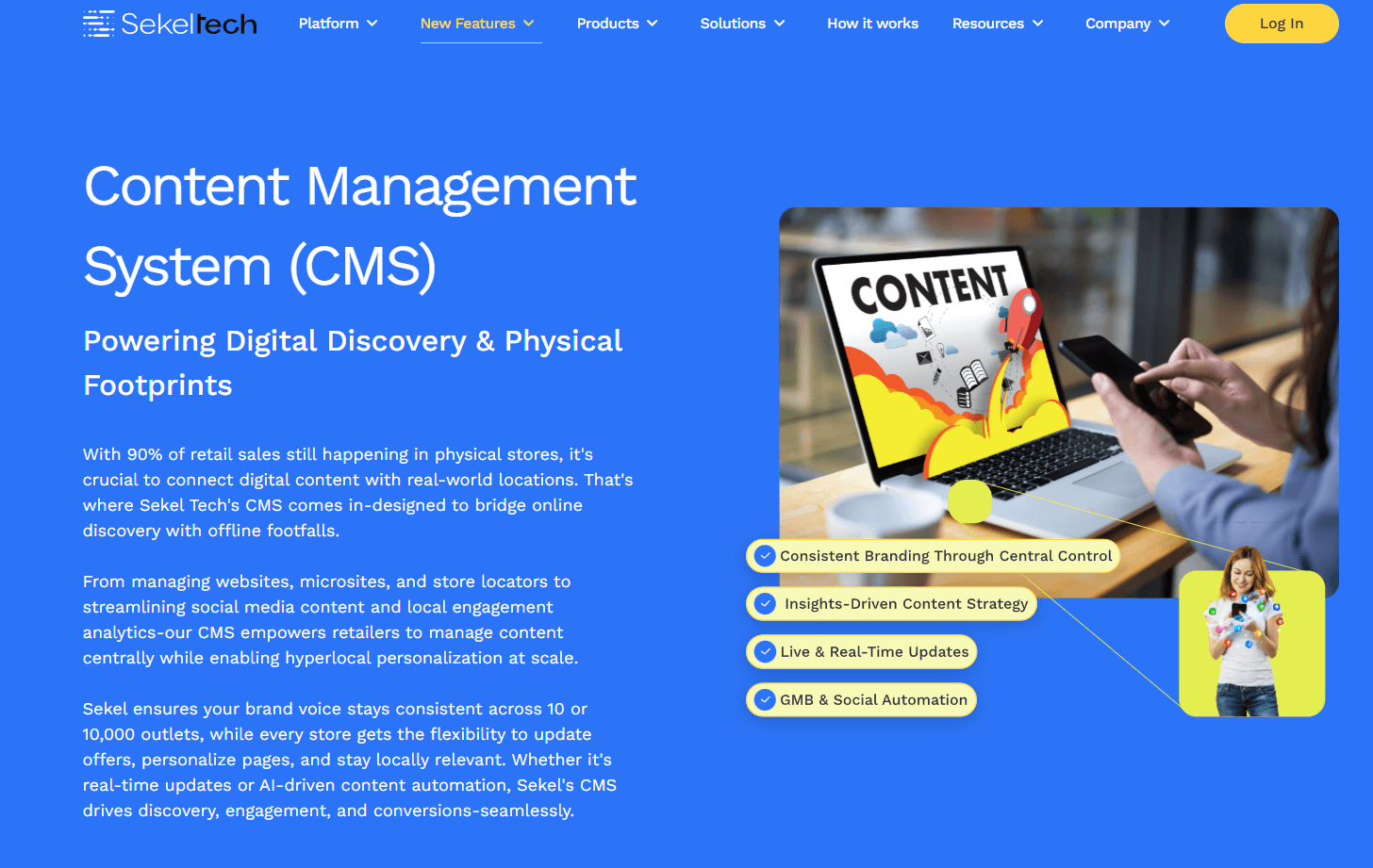
Sekel Tech's platform delivers enterprise-grade multi-location content management for brands operating 100 to 1,000+ locations globally, including Fortune 100 retailers, QSR chains, automotive dealers, and franchise networks.
What Makes It Different:
Built specifically for distributed retail, not adapted from generic CMS tools. The platform combines centralized governance with location-level execution in one unified system.
Core Capabilities
Content Management Suite includes search analytics tracking impressions, clicks, and rankings by store; social media content management across Instagram, Facebook, LinkedIn, YouTube, and Twitter; automated store locator with real-time inventory; microsite generation for every location; bulk Google Business Profile management with scheduling and performance tracking.
Integration Layer connects seamlessly with ERP, POS, CRM, and CDP systems through secure APIs. Real-time synchronization ensures accurate inventory, pricing, hours, and availability without manual updates.
Real Client Results
A 500-store fashion retailer struggled with inconsistent content, outdated listings, and manual Google profile updates taking 40+ hours weekly. They had no visibility into which stores needed marketing support. Sekel implemented automated publishing, unified social and Google Business Profile management, and centralized analytics.
Results within 6 months
- Local search visibility increased 73%
- Direction requests from Google up 58%
- Content publishing time reduced from 3 days to 4 hours
- 12x return on investment in Year 1
Why It Works at Scale
The platform replaces 5 to 7 fragmented tools with one system. Native integration with retail tech stacks (SAP, Salesforce, Oracle). Mobile-first interface for store managers. Proven deployment across clients managing 1,000+ locations.
Watch how the platform converts high-intent local searches into measurable store revenue. "Turn Unknown Visitors into Lifetime Customers with Sekel Tech"
You can also explore this guide by Adobe for Business, “What is a CMS? How content management systems work and why they matter,” for an industry-level overview.
Frequently Asked Questions (FAQs)
1. What are the advantages of multi-location marketing?
It lets you target customers at each location with relevant content while maintaining brand consistency. You show local inventory, neighborhood offers, and accurate store details instead of generic messaging. This improves local search rankings, increases store visits, and boosts conversions because customers find exactly what they need nearby.
2. What is CMS and IMS?
CMS (Content Management System) helps you create and publish website content without coding. IMS (Inventory Management System) tracks stock levels, orders, and product movement. Multi-location businesses often need both integrated so website content reflects actual store inventory in real time.
3. What are examples of CMS platforms?
Popular options include WordPress for general websites, Shopify for e-commerce, HubSpot for marketing-focused sites, and Drupal for complex enterprise needs. For multi-location businesses, specialized platforms like Sekel Tech manage content across hundreds of stores with local customization built in.
4. How many types of CMS are there?
Main types include traditional CMS (WordPress, Joomla), headless CMS (content delivered via APIs), e-commerce CMS (Shopify, Magento), and enterprise CMS (Adobe Experience Manager). Multi-location CMS is a specialized category designed specifically for brands managing content across many physical locations.
5. Is Amazon a CMS platform?
No. Amazon is an e-commerce marketplace where you sell products. It's not a content management system. However, Amazon does provide seller tools to manage product listings, descriptions, and images within their marketplace, but you don't control the overall website or content structure like you would with a CMS.
Conclusion
Multi-location businesses can't compete with generic content anymore. Customers searching locally expect local answers about their nearest store.
A multi-location content management platform delivers this at scale. Corporate maintains brand control while every store gets optimized, location-specific content automatically. Better local rankings, higher conversions, massive time savings.
For businesses managing 100+ locations struggling with manual updates, inconsistent content, or weak local presence, multi-location content management provides the solution.
The businesses winning local search aren't the biggest. They're the ones showing up with the right information when customers search nearby.
Make sure they find you.
Read More Blogs
1. How Dynamic Content Management Tool Drives Hyperlocal Sales
2. GMB Optimisation Tips to Increase Calls, Visits, and Sales
3. Multi-Location Local Engagement Platform: Complete Guide
Share


Similar Blogs
Loved this content?
Sign up for our newsletter and get the latest tips & updates directly in your inbox.
There’s more where that came from!
 Connect with us